Projects don’t fail from lack of tools, They fail from lack of operational clarity.
Projects don’t fail from lack of tools, They fail from lack of operational clarity.
AI Workspace • ProJECT Operations • 5 Weeks • solo desighner
AI Workspace • ProJECT Operations • 5 Weeks • solo desighner

Overview
Nexa is an AI-powered project management platform designed to centralize projects, workloads, documentation, and team collaboration into a single operational workspace.
The Problem
As workflows grow, visibility starts disappearing
Modern teams rely on disconnected systems to manage tasks, communication, files, timelines, and approvals. As projects scale, operational clarity becomes harder to maintain, blockers get buried, and workloads become difficult to balance.
Fragmented Workflows
Teams constantly switch between multiple tools to manage daily operations.
Poor Workload Visibility
Managers struggle to identify overloaded or available teammates in real time.
Overdue Tasks Get Lost
Blocked and overdue tasks become difficult to identify across growing workflows.
Operational Overload
Existing enterprise platforms often feel visually overwhelming and difficult to scan.
Research
Understanding why projects become harder to manage
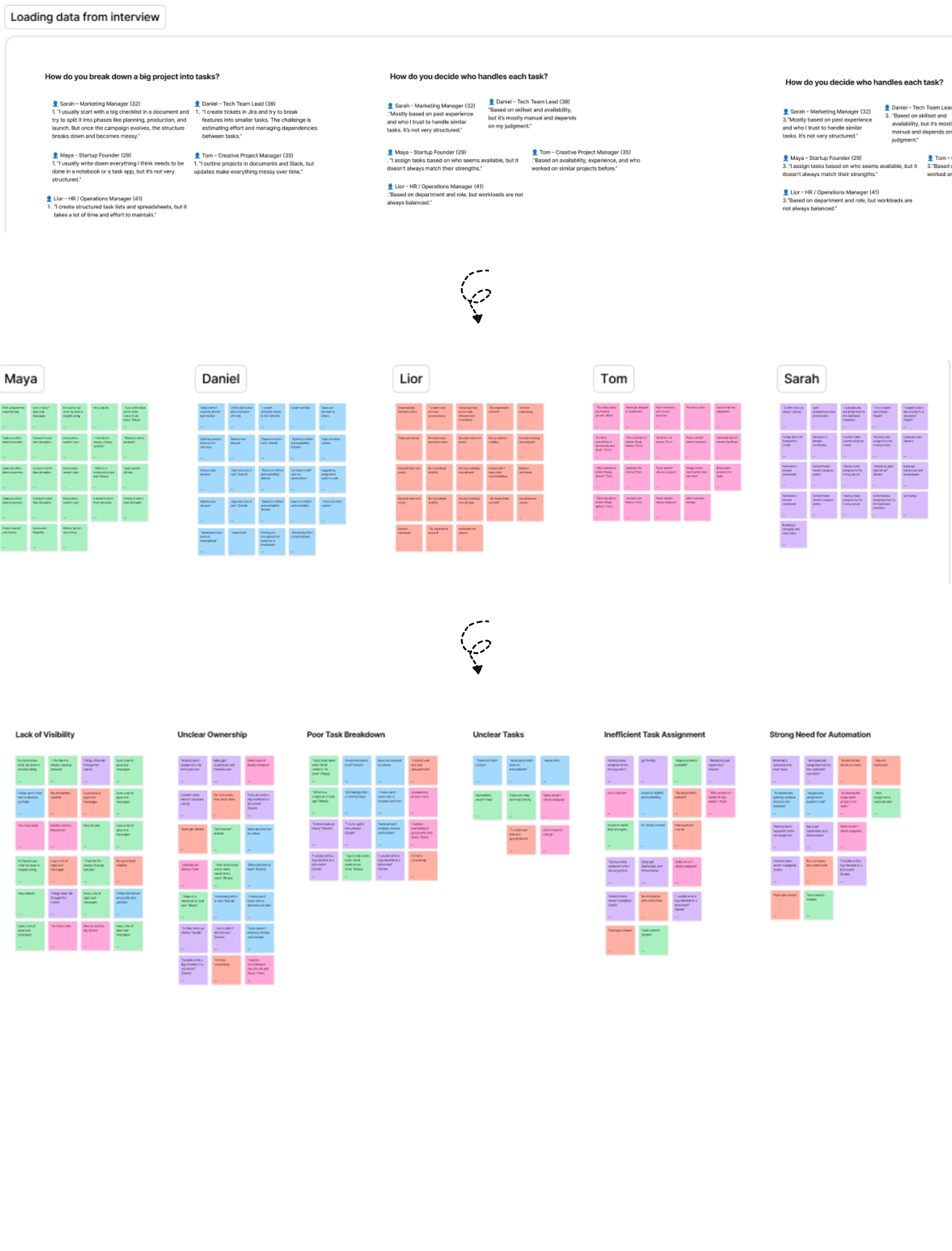
As projects grow, teams rely on more tools, workflows, and communication channels to stay aligned. The research explored where operational visibility breaks down, what creates friction, and why project managers struggle to maintain control.

The Opportunity
Designing workspace for operational clarity
The goal was to design a scalable platform that helps teams manage projects, workloads, blockers, timelines from one centralized workspace. The platform also needed to integrate AI in a way that feels useful, contextual, and operationally relevant .
Improve Operational Visibility
Help teams understand project status faster.
Balance Team Workloads
Improve visibility across team capacity and workload distribution.
Simplify Workflow Management
Reduce friction across tasks, timelines, and collaboration.
Integrate AI Naturally
Use AI to support operational decisions without overwhelming users.
Three recurring patterns shaped the product direction
After synthesizing the interview findings through affinity mapping, three consistent patterns emerged across different roles. These insights became the foundation for the product strategy and guided every major design decision.
1
Limited Workload Visibility
I often realize someone is overloaded only after deadlines start slipping
Daniel, Operations Manager
2
Delays Are Detected Late
By the time I notice a delayed task, it's already affecting other teams
Maya, Project Manager
3
Fragmented Project Visibility
I spend more time searching for information than actually moving the project forward
Sarah, Product Lead
IDEATION
Turning insights into design opportunities
To bridge the gap between research and design, I translated the key insights into "How Might We" questions. These questions helped explore multiple solution directions while keeping the focus on the users' biggest challenges.

How might we help managers identify project risks before they impact delivery?
How might we improve workload visibility without overwhelming users?
How might we centralize tasks, files, and communication into one workspace?
How might AI support decision making without disrupting existing workflows?
from existing products to identify opportunities
I analyzed leading project management platforms to understand common interaction patterns, identify usability gaps, and uncover opportunities to create a more focused experience for project managers.


Complex Interfaces
Most platforms offer extensive functionality, but the amount of information often creates visual overload.
Fragmented Workflows
Critical project information is frequently distributed across multiple views, making navigation less efficient.
AI Feels Separate
AI is commonly implemented as a standalone feature instead of being embedded into everyday project workflows.
Design Foundations
From research to interface
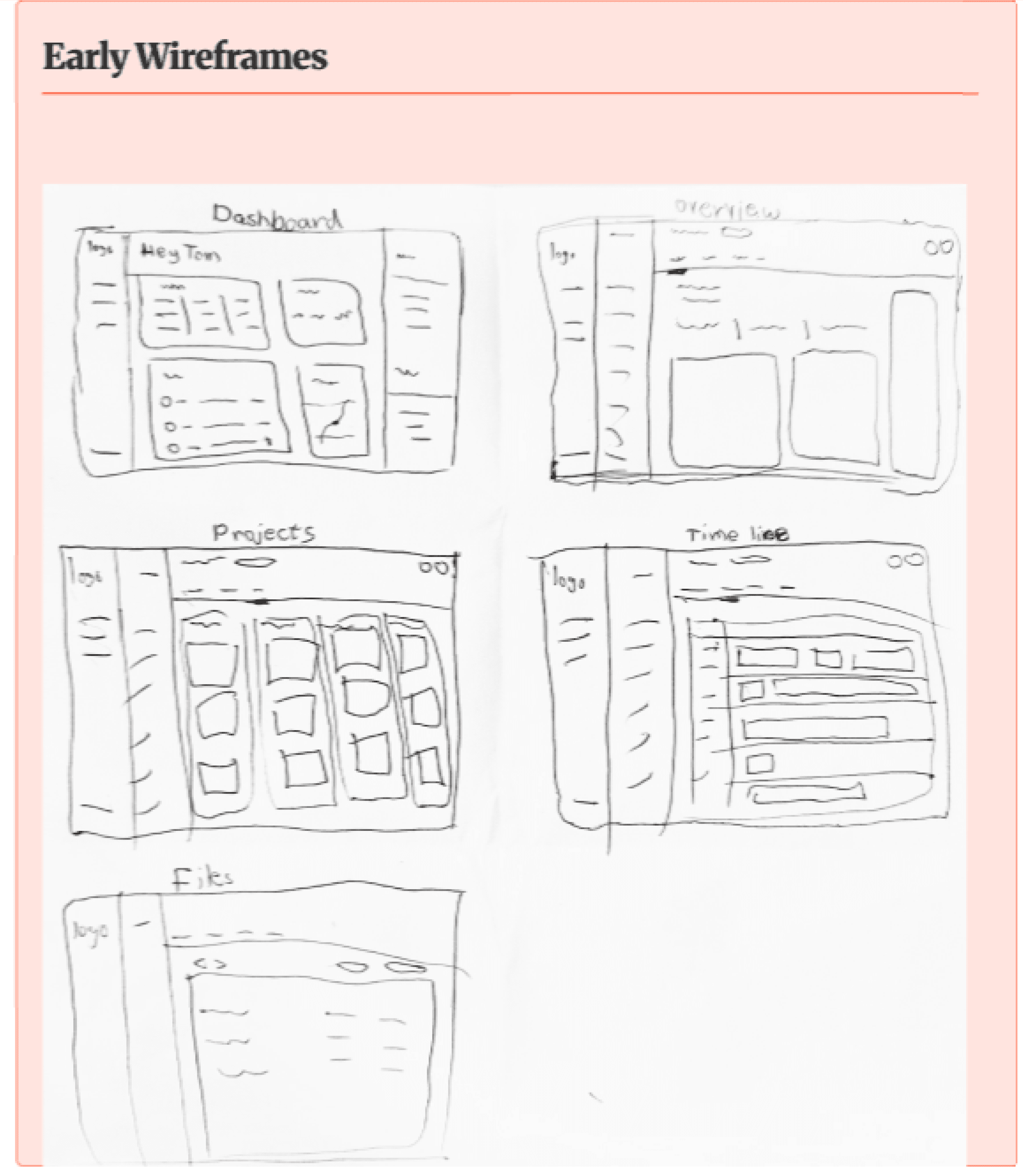
Research insights were translated into the user journey, User flows, and early wireframes to define the product structure before moving into high fidelity design.


FINAL SOLUTION
Designing a simpler way to manage complex projects
A centralized overview of projects, workloads, and AI powered insights.

Visualizing project progress, milestones, and dependencies.

Prioritizes clarity, ownership, and progress to help teams stay aligned.

Visualizes milestones, dependencies, and deadlines in a single timeline.

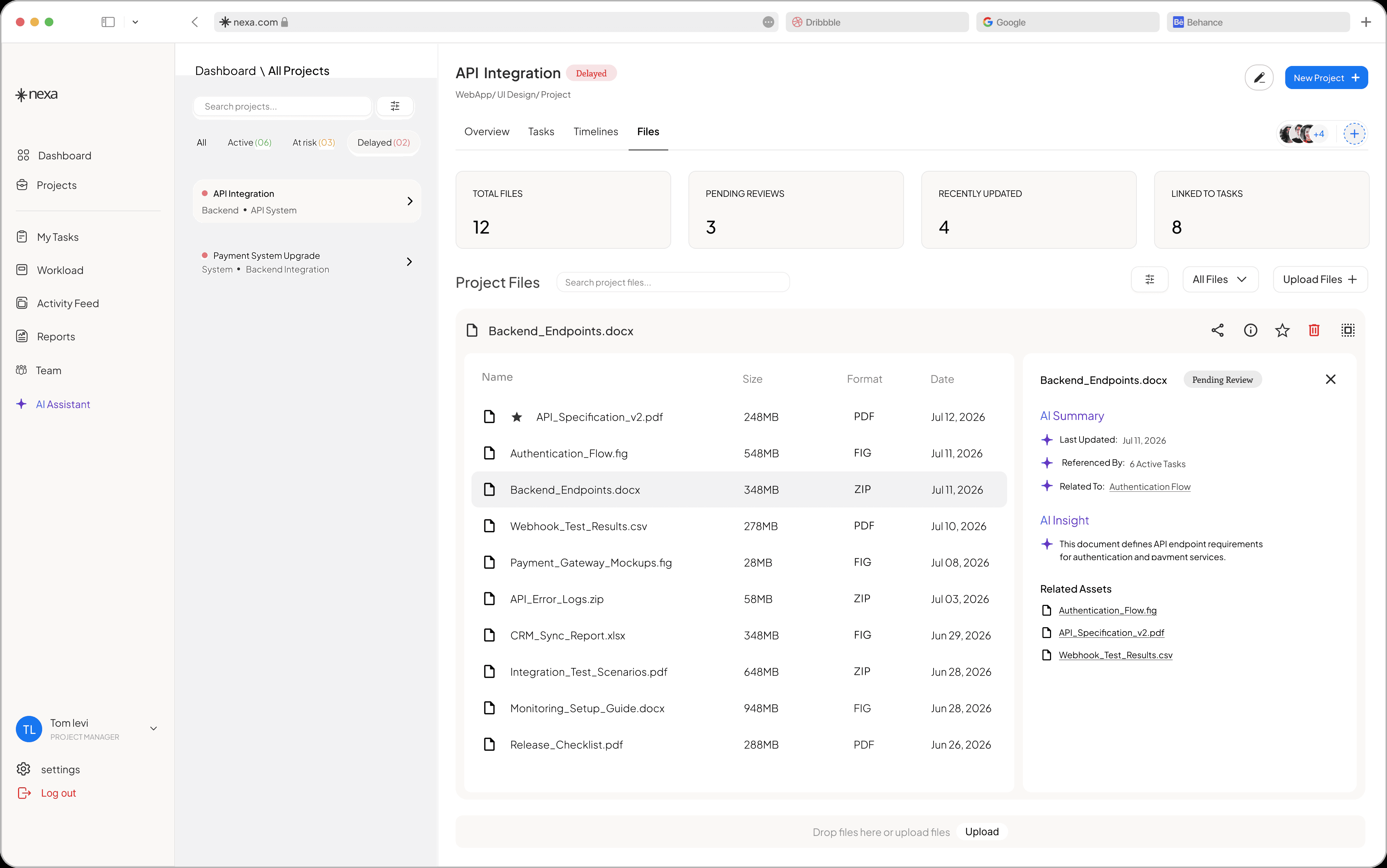
Combines documentation, related assets, and AI-powered summaries to improve accessibility.

Overview
Nexa is an AI-powered project management platform designed to centralize projects, workloads, documentation, and team collaboration into a single operational workspace.
The Problem
As workflows grow, visibility starts disappearing
Modern teams rely on disconnected systems to manage tasks, communication, files, timelines, and approvals.
As projects scale, operational clarity becomes harder to maintain, blockers get buried, and workloads become difficult to balance.
Fragmented Workflows
Teams constantly switch between multiple tools to manage daily operations.
Poor Workload Visibility
Managers struggle to identify overloaded or available teammates in real time.
Overdue Tasks Get Lost
Blocked and overdue tasks become difficult to identify across growing workflows.
Operational Overload
Existing enterprise platforms often feel visually overwhelming and difficult to scan.
Research
Understanding why projects become harder to manage
As projects grow, teams rely on more tools, workflows, and communication channels to stay aligned. The research explored where operational visibility breaks down, what creates friction, and why project managers struggle to maintain control.
The Opportunity
Designing workspace for operational clarity
The goal was to design a scalable platform that helps teams manage projects, workloads, blockers, timelines from one centralized workspace. The platform also needed to integrate AI in a way that feels useful, contextual, and operationally relevant .
Improve Operational Visibility
Help teams understand project status faster.
Balance Team Workloads
Improve visibility across team capacity and workload distribution.
Simplify Workflow Management
Reduce friction across tasks, timelines, and collaboration.
Integrate AI Naturally
Use AI to support operational decisions without overwhelming users.
Three recurring patterns shaped the product direction
After synthesizing the interview findings through affinity mapping, three consistent patterns emerged across different roles. These insights became the foundation for the product strategy and guided every major design decision.
1
Limited Workload Visibility
I often realize someone is overloaded only after deadlines start slipping
Daniel, Operations Manager
2
Delays Are Detected Late
By the time I notice a delayed task, it’s already affecting other teams
Maya, Project Manager
3
Fragmented Project Visibility
I spend more time searching for information than moving the project forward
Sarah, Product Lead
IDEATION
Turning insights into design opportunities
To bridge the gap between research and design, I translated the key insights into “How Might We” questions. These questions helped explore multiple solution directions while keeping the focus on the users’ biggest challenges.
How might we help managers identify project risks before they impact delivery?
How might we improve workload visibility without overwhelming users?
How might we centralize tasks, files, and communication into one workspace?
How might AI support decision making without disrupting existing workflows?
from existing products to identify opportunities
I analyzed leading project management platforms to understand common interaction patterns, identify usability gaps, and uncover opportunities to create a more focused experience for project managers.


Complex Interfaces
Most platforms offer extensive functionality, but the amount of information often creates visual overload.
Fragmented Workflows
Critical project information is frequently distributed across multiple views, making navigation less efficient.
AI Feels Separate
AI is commonly implemented as a standalone feature instead of being embedded into everyday project workflows.
Design Foundations
From research to interface
Research insights were translated into the user journey, User flows, and early wireframes to define the product structure before moving into high fidelity design.
FINAL SOLUTION
Designing a simpler way to manage complex projects
A centralized overview of projects, workloads, and AI powered insights.
Visualizing project progress, milestones, and dependencies.
Prioritizes clarity, ownership, and progress to help teams stay aligned.
Visualizes milestones, dependencies, and deadlines in a single timeline.
Combines documentation, related assets, and AI-powered summaries to improve accessibility.